
Guide · Updated June 2026
AI Search Visibility for Local Businesses
What Small Businesses Need to Know Right Now
Is AI about to change everything for your business? You have spent years getting found the way it has always worked: search, word of mouth, and your reputation around town. Now AI is shifting that, and it raises fair questions. Are you going to miss out? Is this a threat or an opportunity? How much does it actually matter, and what should you do about it today? This guide is a straight read on what is really going on, what to do now, and what nobody has figured out yet. No panic, no hype.
Table of Contents
You have probably seen this yourself. People still go to Google, but now Google often answers with an AI summary right at the top. And some people are starting to ask AI tools like ChatGPT a question directly. Either way, more of them are getting a direct answer instead of clicking through a list of links.
These are real questions people are asking right now, both inside Google's AI answers and in tools like ChatGPT. If your business shows up in those answers, great. If it does not, someone else is getting that recommendation instead of you.
How People Are Searching Now
Where People Actually Search
Here is the reassuring part most of the scary pitches skip: people are not abandoning Google for AI. They are using both, and search still dominates by a wide margin.
The clearest read comes from SparkToro and Datos, using clickstream data from millions of US devices: even as AI use jumped, more than 95% of Americans still regularly use traditional search, a drop of under 1% over two and a half years. AI is mostly adding to how people look things up, not replacing search.
And when you look at where website visits actually come from, StatCounter puts AI chatbots at under half a percent, versus roughly 90% from search (worldwide, May 2026). That counts visits that land on a site, and AI often answers right in the chat without sending a click, so it understates how much AI gets used. But it shows how little website traffic AI actually drives today.
The takeaway: keep winning Google, where your customers already are, and get ahead on AI while it is still small. The most useful next step is to see how Google itself now handles AI, which depends entirely on what someone searches.
What's Changed With Google
For years, local search on Google has worked in a few predictable ways. Someone Googles your name and your business panel shows up with your info and reviews. Someone Googles "Mexican restaurant in Truckee" and the map pack appears: a few local spots with stars, ratings, and a map. People click, call, or get directions. Winning has meant owning that branded result and earning a place in that map pack.
That has not gone away. For most local searches, the map pack and your business panel are still the first thing people see and the thing they act on.
What is new is a layer on top. For certain searches, Google now puts an AI Overview above everything else, and it pulls from across the web, not just from who ranks. (Google also has AI Mode, a chat experience built into Search and powered by Gemini, where people can keep asking follow-up questions.) But it does not show up for every search. It depends on what the person is trying to do. Here is the same kind of Truckee business searched three different ways.
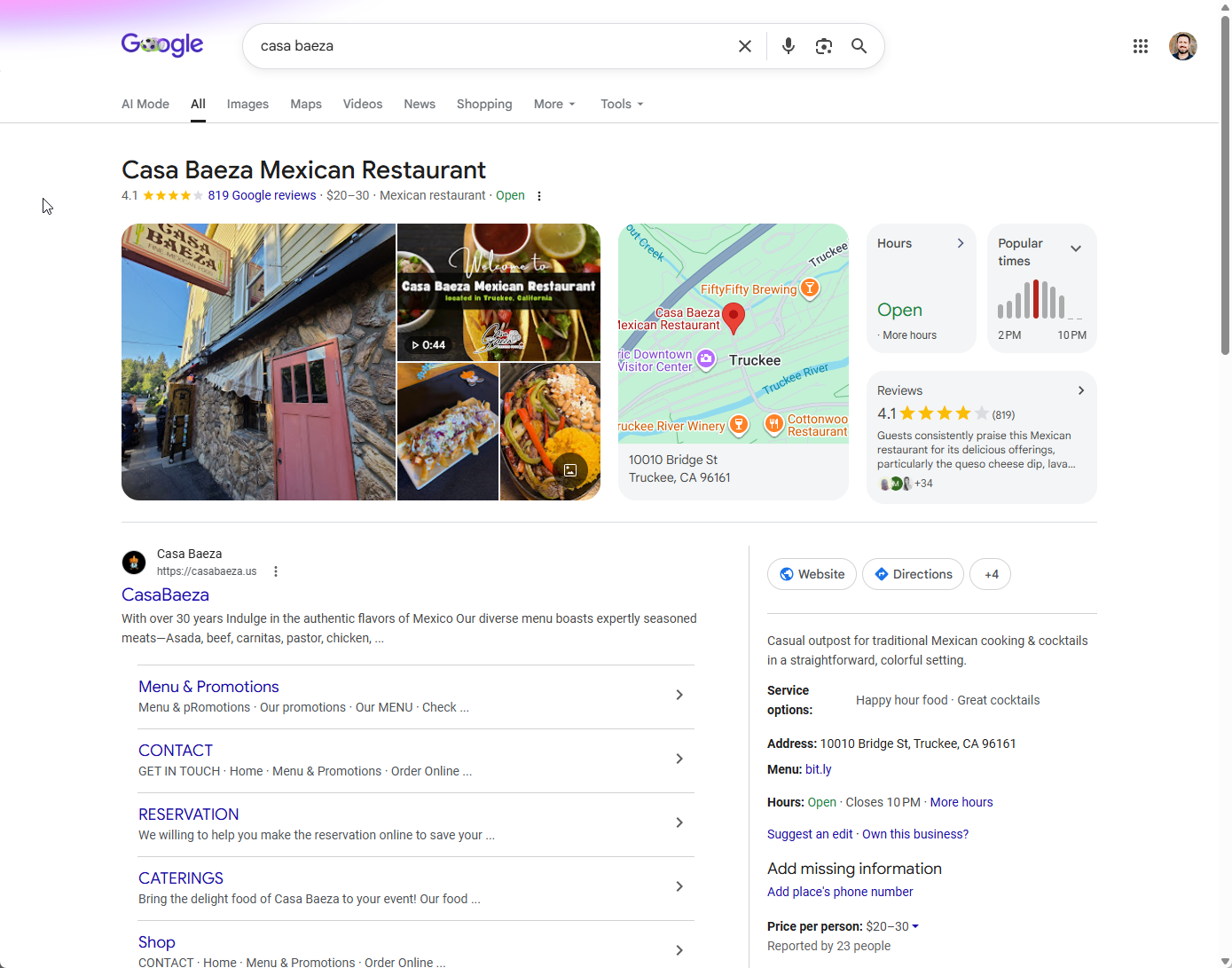
Searching a business by name ("Casa Baeza"). The business panel and reviews show up, same as always. AI rarely changes this.
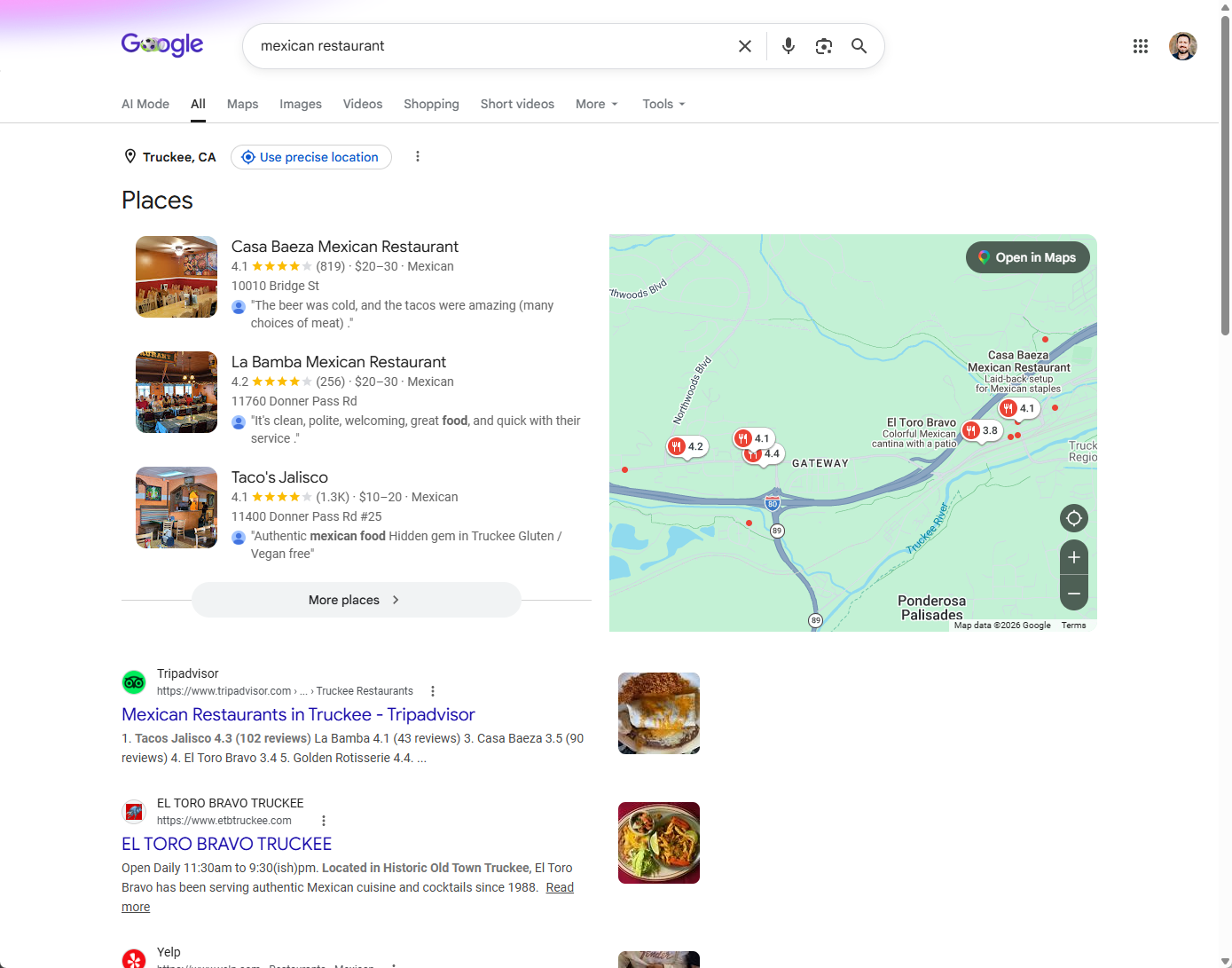
Searching a service ("Mexican restaurant"). The map pack shows up at the top: a few local spots with ratings and a map. Much of the time there is no AI Overview at all. This is still a map-pack game.
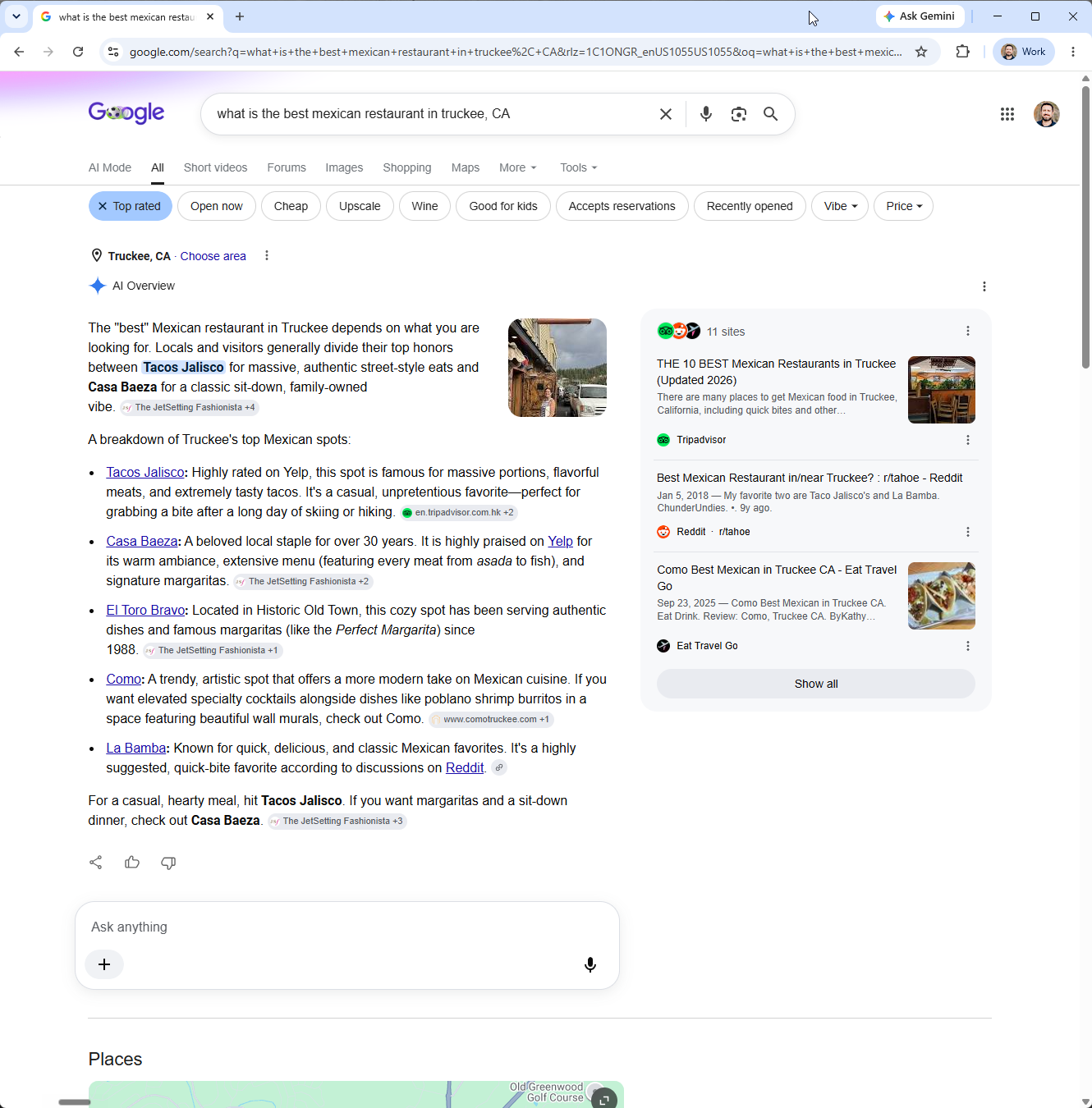
Asking which or who is best ("best Mexican restaurant in Truckee"). This is where the AI Overview tends to appear, on top of everything, pulling from review sites, forums, and best-of lists, with the map pack pushed further down.
The more someone is comparing and researching, the more AI steps in. The more they already know what they want, the more the classic map pack and your business panel still run the show. This keeps shifting as Google changes things, but it is the pattern we see today.
What About the Chat Tools?
So far this is all Google. What about the standalone chat apps people open directly, ChatGPT, Google's Gemini, and Perplexity?
Right now they are a small slice of how people find a local business, and they are growing. They show up most for the same research-style questions ("who is the best...," "compare a few options"). The catch is you cannot buy your way in, and you cannot tune them directly the way you adjust a Google listing.
The good news: you influence them by doing the broader work well. These tools build their answers from reviews across the web, directory listings, and mentions on other sites, the same signals the rest of this guide covers. Get those right and you give every AI tool, Google's and the chat apps, a clear, consistent picture of your business to pull from.
Keep an eye on the chat tools, but put your effort into the signals that feed all of them.
What It Means and How AI Decides
What It Means For You
When an AI answer does show up, it changes how the search plays out. Here is the difference:
Traditional Search
- → Type query into Google
- → Scroll through results
- → Click on a few websites
- → Make a decision
AI-Powered Search
- Ask a question or read the AI summary
- Get a direct answer with recommendations
- Maybe click one link to confirm
- Make a decision
The second version skips the part where someone browses your website and compares you to a few competitors. The AI did that comparison for them.
The practical result is what people call zero-click: fewer visits to your website, more of the decision happening right on Google, and a customer who often already knows your name, your rating, and what you do before they ever reach out. That shifts the goal. It is less about winning the click and more about being the business the AI names, and making sure what it shows about you is complete and good.
When AI is in the picture, showing up in the answer matters as much as ranking in the list.
How AI Decides Who to Recommend
Branded searches are the easy ones. Once your basics are right, AI and Google just need to find accurate information about a business someone already named. The real competition is the service and research searches from earlier, where the customer does not know you yet and something has to choose you over everyone else.
Nobody has the exact formula for that. This is not like Google where we have 20 years of SEO research. But based on what we are seeing, AI systems tend to recommend businesses that have:
The surprise: ranking #1 on Google does not get you into the AI answer. One 2026 study found a top-10 Google ranking gives only about a 25% chance of being cited in an AI Overview, and Google's new AI-powered local packs show only about a third as many businesses as the regular map pack. AI pulls from a broader, different set of signals.
Volume, recency, and quality across multiple platforms. Not just Google. Yelp, Facebook, and industry-specific sites all feed into AI models.
AI needs to understand what you do, where you do it, and what makes you different. If your website is vague, AI will be vague about you too.
Same business name, address, and phone number across every listing. When AI sees conflicting info, it loses confidence in recommending you.
Mentions in local news, chamber listings, industry associations, and expert-curated best-of lists. Those best-of lists topped the 2026 expert ranking of what drives AI visibility, they are hard to game, which is exactly why AI trusts them.
Detailed service descriptions, FAQs, pricing info, and content that directly answers the questions people are asking AI.
If this list looks familiar, it should. Most of these are the same things that help with traditional SEO. The difference is that AI also weighs sources beyond Google, and it cares more about entity recognition (does it know your business exists as a real thing) than about backlinks.
Where AI Pulls Its Answers From
This might be the most useful part of the whole guide, and the best news in it: the AI tells you exactly where it got its answer. Take that "best Mexican restaurant in Truckee" search from earlier. The AI named a few spots, and off to the side it listed every source it used. Here is that source list.
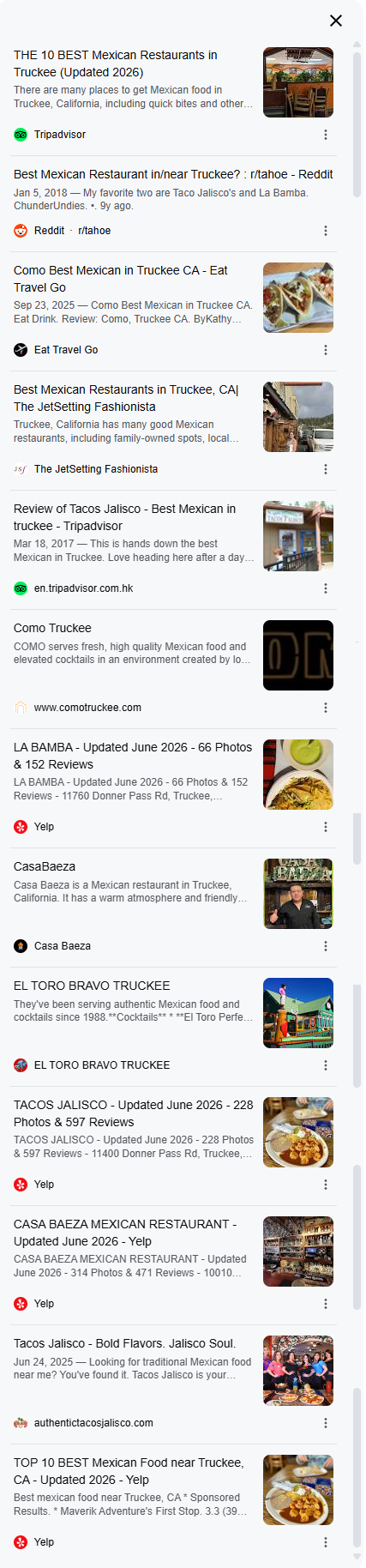
Look at the sources. They are the pages the wider web trusts: TripAdvisor (including its "THE 10 BEST Mexican Restaurants in Truckee" list), Yelp, a Reddit thread, and local food blogs. The AI is mostly summarizing what other sites say about these restaurants, not what they say about themselves.
But notice this: a couple of the restaurants are cited straight from their own websites. Casa Baeza and Como both show up pulled from their own sites, because those sites clearly state what they are, where they are, and what they serve. A clear, specific page on your own site can earn the citation too.
So here is the cheat sheet: run that exact search for your own business and town. Make sure you are listed, accurate, and well-reviewed on every site the AI cites, and if it keeps quoting a "best of" or "top 10" list, get onto that list. Then give the AI a clear page on your own site that plainly answers "why are you the best in your area," with specifics it can quote. The AI is showing you the path, and most businesses never look.
And it does not stop at the first answer. Right below the AI Overview is an "Ask anything" box, where people keep digging: "which is best for a big group?", "who has the best margaritas?". The conversation continues, and each follow-up pulls from those same kinds of sources, so being consistently present across them matters even more.
The chat tools work the same way, just from a slightly different mix of sources. ChatGPT leans on review sites, forums, and businesses' own pages; Claude, for restaurants, leans on Google's own ratings and reviews. Different tools, same lesson: get strong on the sources, and you show up across all of them.
What You Can Do Right Now
There are two things to do here, and the best part is the AI hands you one of them for free. Do both: mine the exact sources the AI is already using for your category (specific, fast, and where I would start), and shore up the foundations underneath (which lift your AI visibility and your normal Google ranking at the same time).
Start With What the AI Is Already Telling You
Earlier we saw that the AI lists its sources. Here is how to turn that into a to-do list for your own business. Open Google, ChatGPT, and Claude, tell each one to ignore your history, and ask "best [your category] in [your town]." Each names a few businesses and shows you (or tells you, if you ask) exactly which sources it used.
The key: they pull from different places, so check all three. Same question, three engines, three different sets of sources.
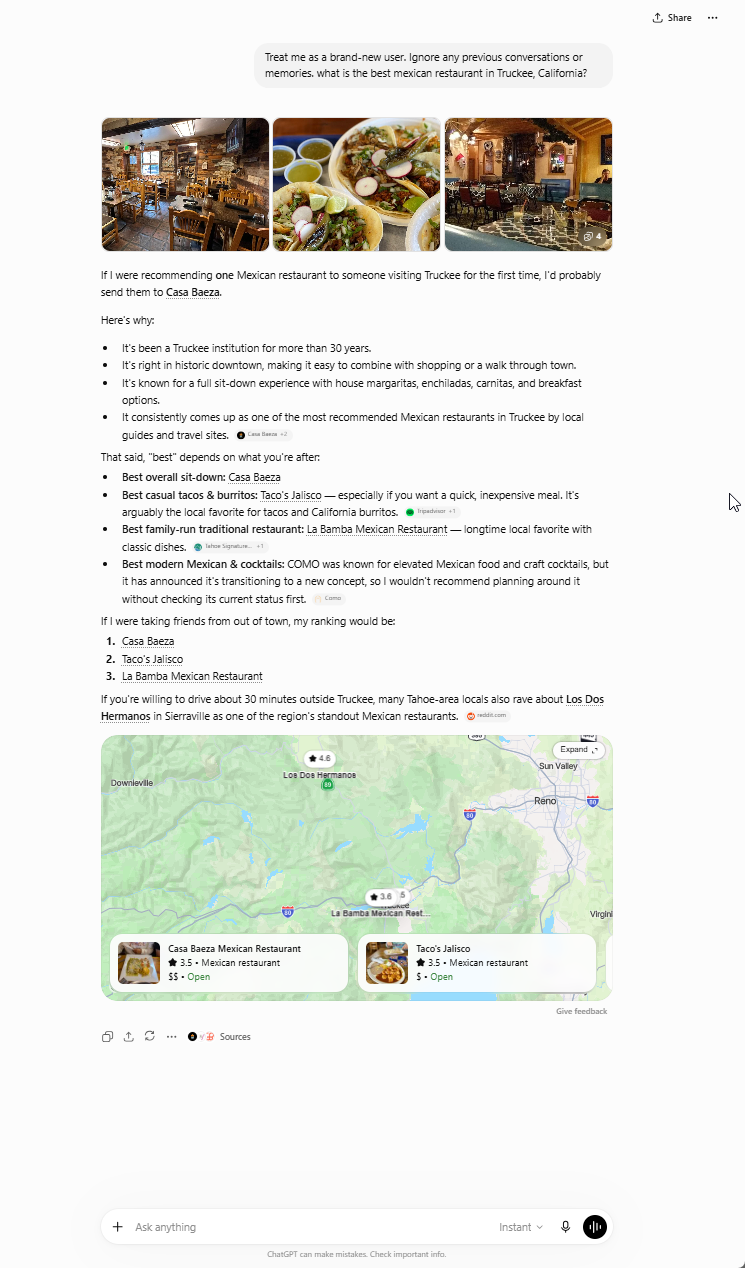
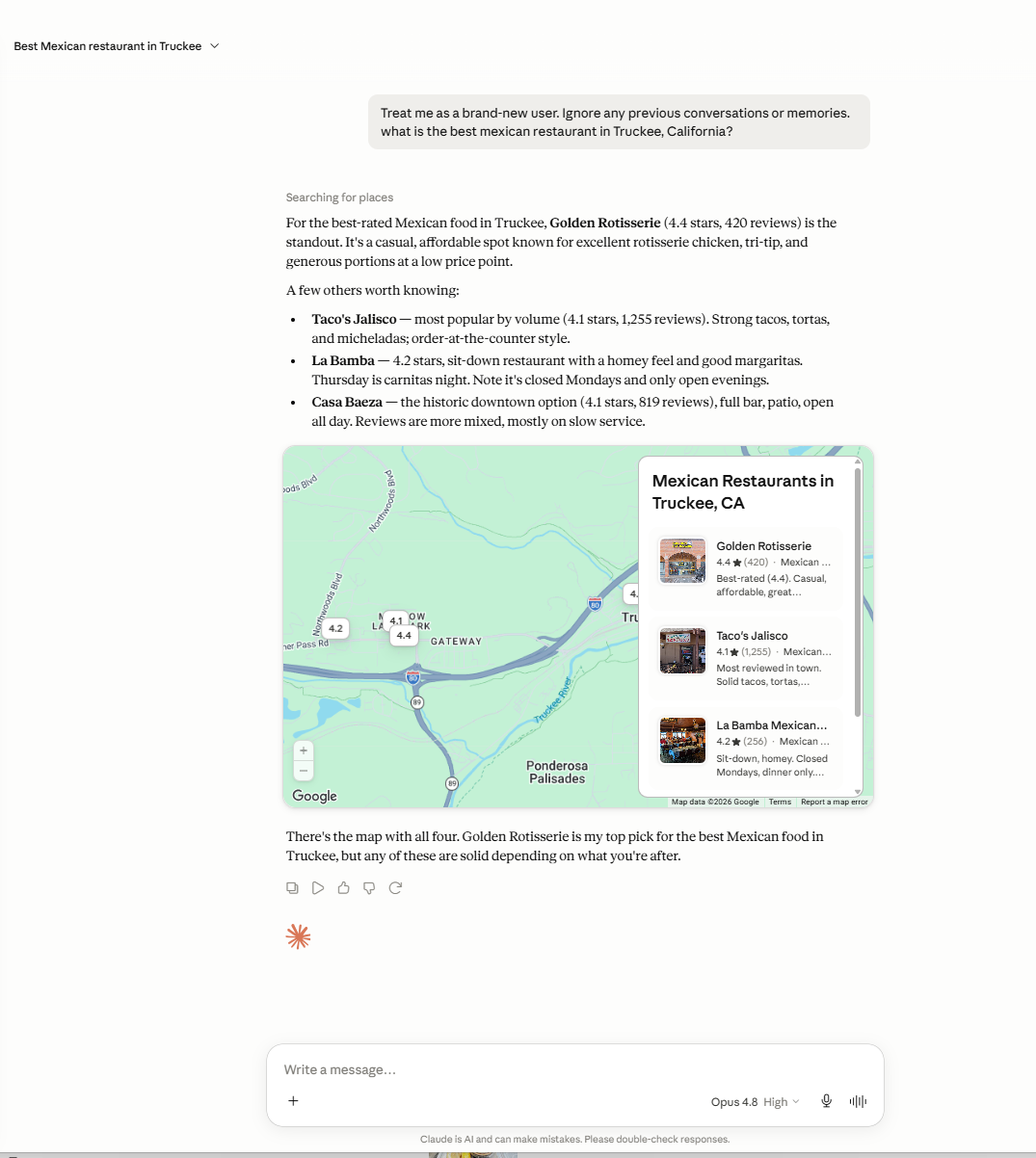
Now you have a map of every source feeding the AI for your category. Act on it:
- If a "top 10" or "best of" list keeps appearing (TripAdvisor, a local blog), figure out how to get listed on it.
- If it leans on a platform like Yelp, strengthen your Yelp: claim it, add photos, keep reviews fresh.
The biggest hack: write your own page.
The AI quotes a business's own website when the page makes a clear case. So build one page that plainly argues why you are the best, your "why we are the best Mexican restaurant in Truckee" page, and load it with proof: testimonials, awards you have won, what you do better, real specifics. You control this one completely, and the AI can lift it straight into its answer.
This is the targeted prong: it tells you exactly where to aim. The foundations below are the base that helps every search, AI or not.
The Foundation Still Matters
Those targeted moves work best on a solid base. If your website is unclear, your Google Business Profile is incomplete, or your reviews are thin, shore those up too. AI search does not replace the foundation, it builds on it, and the same foundation carries your normal Google ranking, your knowledge panel, and your map pack.
If you have not already, read our SEO guide and local marketing guide. Everything in those still applies. What follows here is the additional layer on top.
Reviews Across Platforms
For traditional SEO, Google Reviews were the main focus. For AI visibility, reviews on other platforms matter more than they used to.
Platforms AI pulls reviews from:
- Google Business Profile
- Yelp
- Apple Maps
- Industry-specific sites (Houzz, Avvo, Healthgrades, etc.)
What to do:
- Keep asking for Google Reviews (still #1 priority)
- Make sure your Yelp profile is claimed and accurate
- Do not ignore Facebook reviews
- Respond to reviews on every platform
- Do not need to actively push people to Yelp, just make sure it is not neglected
Google Business Profile is still the most important single listing. But for AI visibility, the other platforms are no longer optional to at least maintain.
One thing that matters more than people expect: keep reviews coming in steadily. A fresh, ongoing flow counts for more than a big pile of old reviews. Make asking part of your routine, a couple a week, not a once-a-year push.
Content That AI Can Actually Use
AI systems need clear, specific information to recommend your business. Vague marketing copy does not help them. Here is what does:
Write content that answers questions:
- What specific services do you offer?
- What areas do you serve?
- What makes your approach different?
- What do customers typically ask you?
- What does your pricing look like? (even ranges help)
Skip the fluff:
- "We are passionate about excellence"
- "Our team of dedicated professionals"
- Buzzwords that say nothing specific
- Walls of text with no structure
Think of it this way: if someone asked you "what does this business do and why should I go there?" your website should answer that question clearly in the first few seconds. That is what AI is looking for too.
Listings and Citations
Citations have always mattered for local SEO. For AI visibility they matter even more, because they are literally where the AI gets its answer. Start with the cheat sheet from earlier: run your own "best [your service] in [your town]" search, see which sites the AI cites, and make sure you are listed and strong on every one. Pay special attention to any "best of" or "top 10" list, the AI trusts those because they are hard to fake. Then cover the baseline directories below so your business is confirmed everywhere.
Priority listings for AI visibility:
The key thing with all of these: consistency. Your business name, address, and phone number should be exactly the same everywhere. When AI sees conflicting info across platforms, it either picks the wrong detail or skips you entirely.
If you only have a Google Business Profile and a website right now, you are invisible to a lot of the AI ecosystem. Getting listed on the major platforms is one of the highest-impact things you can do.
Structured Data (Schema Markup)
Structured data is code on your website that tells search engines and AI exactly what your business is in a format they can read easily. Think of it as a cheat sheet for machines.
Without structured data:
AI has to read your whole website and figure out what you do, where you are, and what your hours are.
With structured data:
AI gets a clean, organized summary: business name, type, location, services, hours, reviews. No guessing.
The most useful types for local businesses:
This is a technical thing your web developer handles. But it is worth asking if your site has it. Many do not.
Want to see how your business shows up in AI search?
Get Your Free AuditCommon Questions
Should I Focus on Yelp Again?
This is one of the most common questions we are getting right now. The short answer: you do not need to go back to actively building your Yelp presence the way you might have in 2015. But you should not ignore it either.
Here is why it matters now: ChatGPT pulls heavily from Yelp when making local business recommendations. If your Yelp profile has outdated info, no photos, or a handful of old negative reviews with no responses, that is what ChatGPT sees.
The practical approach:
- Claim your Yelp profile if you have not already
- Make sure hours, services, and contact info are current
- Respond to existing reviews (especially negative ones)
- Add current photos
- Do not pay for Yelp ads or push customers to review there instead of Google
- Google Business Profile is still your #1 priority
Think of Yelp as maintenance, not a strategy. Keep it accurate. Do not let it become a liability.
Is SEO Dead?
No. People have been asking this every few years since 2010, and the answer has always been no.
Google is still where most people start when they need something. Google Business Profile is still the most important single listing for a local business. Traditional SEO still drives the majority of local leads for most businesses.
What is changing is that SEO is no longer the only game. AI search is a new channel, and it is growing. The good news is that most of the things that help with AI visibility are the same things that help with SEO. Clear website, strong reviews, consistent listings, good content.
SEO is not dead. But if it is the only thing you are doing, you are leaving opportunities on the table.
Can I Pay for AI Placement?
Not really. Not yet, anyway. There is no "Google Ads for ChatGPT." You cannot pay to be recommended by Perplexity. Google AI Overviews do not have a paid placement option as of mid-2026.
This will almost certainly change. These companies will eventually figure out how to monetize AI answers with some form of advertising. But right now, the only way in is to earn it.
That is actually good news for small businesses. The playing field is relatively level right now. The businesses that invest in building a strong, consistent presence across platforms are the ones showing up. Not the ones with the biggest ad budget.
Tools & Tracking
Manual Testing You Can Do Today
You do not need a paid tool to get started. Open up ChatGPT, Perplexity, and Google, and try asking these questions about your own business and industry:
Write down what comes back. Are you mentioned? Are your competitors? Is the information accurate? This gives you a baseline and often reveals things you did not expect.
Tracking Tools (Early Days)
As of mid-2026, dedicated tools for tracking AI search visibility are just starting to come out. The major SEO and local marketing platforms are racing to add AI visibility tracking, and we are actively testing the ones that look most promising.
These tools are brand new. The data is not perfect yet. But they are getting better fast, and they give you things like:
We are also running our own local tracking. We test common search queries for key Truckee, Tahoe, and Reno industries, focused on the two that matter most for local: Google's AI Overview and ChatGPT. We track which businesses get recommended, how the answers change over time, and what the top-recommended businesses have in common.
This is something we can do for your business and your industry. If you want to know where you stand right now and how that changes over time, reach out for a free audit and we will include an AI visibility check.
What to Measure
Whether you are doing manual checks or working with someone who has tracking tools, here is what to pay attention to:
Right now, the most important metric is simple: does AI know you exist? Start there.
What We Don't Know Yet
The Honest Gaps
We are going to be straight with you. This space is moving fast and nobody has all the answers yet. Here is what we are still figuring out along with everyone else:
What is the exact weight of each signal?
We know reviews, listings, and content matter. We do not know the exact formula. Each AI platform weighs things differently, and they are all constantly changing.
Will AI search replace Google?
Probably not anytime soon. But it is definitely taking some search volume, especially for recommendation-type queries. The right move is to be visible in both.
How fast do AI systems update?
Some pull live data (Perplexity, Google AI). ChatGPT updates less frequently. If you fix something on your website today, it might not show up in ChatGPT for weeks or months.
We will update this guide as we learn more. The tools are getting better, the data is getting clearer, and best practices will solidify over the next year. For now, the best approach is to do the fundamentals well and keep paying attention.
AI Search Readiness Checklist
Foundation
- Google Business Profile fully completed
- Website clearly explains what you do and where
- Consistent NAP across all listings
- Structured data on your website
- Google Search Console set up
Presence
- Yelp profile claimed and current
- Apple Maps listing created
- Facebook business page active
- Listed on the directories the AI cites + local chamber
- Reviews on multiple platforms
Authority
- A page making the case for why you are the best
- On the "best of" / top-10 lists the AI cites
- FAQ content answering common questions
- Local press or media mentions
- Detailed service pages
- Manual AI search testing monthly
Final Thoughts
AI search visibility is not something you need to panic about. But it is something you should start paying attention to. The businesses that build a strong, consistent presence across platforms now are going to be the ones that show up in AI answers as these tools grow.
The good news is that most of the work overlaps with what you should already be doing for local SEO. Get your listings right, keep your reviews healthy, make your website clear and specific, and build your authority in your community.
If you want help figuring out where you stand and what to do first, get a free audit. We will check your current visibility across both traditional search and AI platforms and give you a clear plan.
The rules are still being written. But the businesses that show up early tend to stay ahead.
Sources & Notes
The figures in this guide come from research published by local-search analysts and tools. They are directionally consistent and cross-checked against each other, but they are industry research, not independent academic measurement. This area moves fast; figures were current as of mid-2026.
- Whitespark, The Prevalence of AI Overviews in Local Search (2025): AI Overviews appear on ~68% of local queries, but only ~15% of direct "near me" searches.
- Whitespark, Guide to Google's AI Mode for Local Businesses (2026): a top-10 Google ranking gives ~25% odds of an AI Overview citation.
- Whitespark, Local Search Ranking Factors 2026: 47 experts weight what drives AI visibility.
- Sterling Sky, The State of Local SEO in 2026: AI local packs show ~32% as many businesses as the regular map pack.
- BrightLocal, Local Consumer Review Survey 2026: 45% of consumers report trying AI for a local recommendation, up from 6%.
- Ahrefs, ChatGPT vs Google referral traffic tracker (2026): Google sends roughly 190x more referral traffic than ChatGPT.
- StatCounter Global Stats (May 2026): Search vs Social vs AI Chatbot (search ~91%, AI chatbot ~0.4% of website referrals), Search Engine Market Share (Google ~90%), and AI Chatbot Market Share (ChatGPT ~77%). Measures referral traffic to websites, not total query volume.
- SparkToro & Datos, research on AI vs traditional search usage (2025): 95%+ of Americans still regularly use traditional search (under 1% decline over 2.5 years); AI is additive, not a replacement.
Want to Know Where You Stand?
We will check how your business shows up in both traditional search and AI platforms. Free audit, no strings.
Get Your Free Audit